Focused tutorial
How to Analyze Ad Creatives with Winning Hunter
Turn a small set of relevant ads into one original ad creative brief: a customer problem, a hook, a proof idea, an objection to address, and a measurable test.
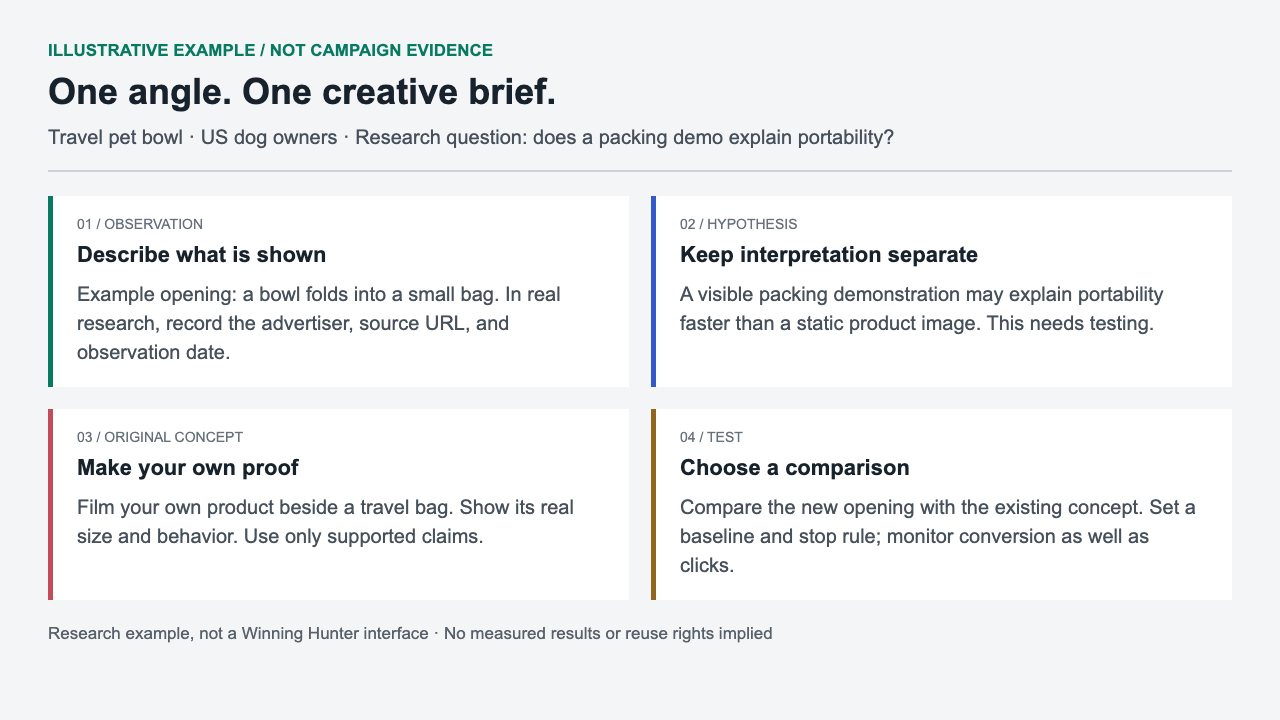
Task and result
Analyze one angle, not an entire niche
The task is ad creative analysis for one product category in one market. The result is a short brief that a creator can act on, with source links and uncertainty notes. Winning Hunter helps you find examples; judgment comes from reviewing what each ad actually says and shows.
This tutorial is research-based, checked on October 8, 2026. The official Facebook research page advertises spend, media-type, and performance filters. We have not executed these steps in a paid account. Use available controls rather than assuming a particular button label or feature is included in your plan.
Requirements for a useful ad creative brief
- An account with access to relevant ad creative search and detail views. If you are starting free, confirm the trial restrictions first.
- One product category, target customer, country, language, and preferred media type. For example: a portable pet bowl for US dog owners.
- A specific question, such as whether a visible packing demonstration explains portability more clearly than a static product image.
- An ad creative worksheet with source URL, advertiser, observation date, opening hook, proof, objection, offer, and uncertainty fields.
- Your own product facts, approved claims, and original or licensed footage for the eventual concept. Discovery does not grant permission to reuse another ad.
If access is unclear, start with the free trial guide. If you need a product shortlist before creative work, use the product validation tutorial first. This task starts after you have chosen a category to study.
Step-by-step ad creative analysis
1. Write a narrow ad creative search brief
Record your category, market, language, and question before opening search. Use a product term, a problem term, and a known advertiser as separate entry points. Keep the intended ad creative format consistent so a long video is not judged against a static image without context.
2. Collect a small, comparable set
Find three to five relevant examples using the controls available in your account. Where supported, narrow by country, media type, and recent activity. Record the date and link for every ad creative. Spend or engagement filters can prioritize inspection; they cannot tell you the campaign's profit.
3. Separate the ad creative hook from the product
Review the opening scene or first line, then record the problem it presents. For a video, note what appears in the opening few seconds. For a static ad creative, note the first visual claim. Write an observation such as shows a bowl folding into a bag, rather than an interpretation such as this hook converts.
4. Identify ad creative proof, objection, and offer
Note whether the ad creative demonstrates the product, uses a testimonial, or makes an unsupported claim. Identify the objection being answered: size, cleanup, delivery, price, or another concern. Open the live landing page and check that its current offer matches the ad. Record missing proof as a gap.
5. Compare patterns without copying
Group repeated angles across independent advertisers. A reused ad creative is not a new observation. Write one hypothesis about why the angle may help your intended customer, then design an original opening with your own product and assets. Keep the hypothesis separate from the source observation.
6. Choose one test and a stopping rule
Finish the ad creative brief with a variant, a comparison, and a metric. For example: compare an original packing demonstration with your existing static concept, using your own click-through baseline and monitoring conversion cost. Decide the budget, duration, and stop rule before launching; none of those values are supplied as a guarantee here.
Worked example: an illustrative travel pet-bowl brief
The rows below are invented to demonstrate the method. They are not observations from a real advertiser, a product test, or verified campaign performance.
| Brief field | Illustrative entry | Human check |
|---|---|---|
| Ad creative observation | An example opening shows a bowl folding into a small bag. | In real research, attach the ad URL, advertiser, and observation date. |
| Customer problem | Carrying bulky pet equipment on short trips. | Confirm this problem with independent customer feedback. |
| Ad creative hypothesis | A visible packing demonstration may explain portability faster. | Treat it as a testable idea, not a performance finding. |
| Proof requirement | Show the real product folding and being packed without editing tricks. | Confirm size, material, and the product's actual behavior. |
| Original ad creative | Film your own product beside your own travel bag; use factual captions. | Check rights, claims, and accessibility of captions. |
| Ad creative test | Compare the new opening with the existing concept. | Set your baseline, budget and stop rule; monitor conversion as well as clicks. |
Your finished ad creative analysis should make those distinctions easy to see. If a teammate cannot tell an observation from a hypothesis, revise the brief before producing footage.
Ready to build your own ad creative brief?
Open Winning Hunter and collect a small set of relevant examples for the task above. Keep source links, observations, and hypotheses separate.
Common mistakes that weaken ad creative analysis
- Calling an ad successful because it has many likes or has run for a long time. Those signals do not reveal margin or acquisition cost.
- Mixing markets, languages, or media formats without noting the difference. The same opening can mean something different to another audience.
- Copying footage, testimonials, or claims into an original ad creative brief. Research identifies questions; it does not grant rights or substantiate your claims.
- Collecting dozens of near-duplicates instead of answering one question. Stop when the brief is actionable and search again only for a named gap.
Quality check before producing an ad creative
| Check | Pass condition |
|---|---|
| Traceable evidence | Every real ad creative example has a source URL, advertiser and observation date. |
| Clear reasoning | The brief separates observed content from a proposed explanation. |
| Manual offer verification | The current product and landing-page claims match what you plan to show. |
| Original production | Footage, audio, testimonials, and claims have appropriate permission or support. |
| Measurable next step | One ad creative hypothesis, one comparison, and a predetermined evaluation rule. |
Do not publish the ad creative merely because every research field is filled. A human still needs to check product truth, permissions, platform rules, and whether the concept represents your offer fairly.
Next steps after the brief
Use the validation workflow if the unresolved issue is product or supplier fit. Check pricing when repeated ad creative sessions hit a specific access limit. Use the Pipiads comparison for credit-budgeted TikTok/Facebook discovery or the AdSpy comparison for comment and affiliate-offer search. For account questions, continue to FAQ.
Ad creative analysis FAQ
How many examples do I need for an ad creative brief?
Begin with three to five relevant examples under the same market, language, and media constraints. This is a practical starting point, not a statistically representative sample or a proven optimum.
Does this tutorial show a tested Winning Hunter account?
No. It is a research-based method grounded in the official Facebook ad research page. The sample brief is illustrative, not a paid-account capture or a report of campaign results.
Can I copy a competitor's ad creative?
Do not assume discovery grants reuse rights. Study the problem, proof, and objections, then make an original concept with your own or licensed assets and substantiated claims.
What if my account does not show the described filters?
Use only the filters available in your account and record what is missing. Interface labels and plan access can change. Check support or pricing if a missing filter prevents the task.
What is a useful test metric after ad creative analysis?
Choose one metric tied to the hypothesis, such as click-through rate for a clearer opening, while monitoring conversion and cost. Set your own baseline and stop rule before launching; this tutorial provides no guaranteed target.
When should I stop collecting ad examples?
Stop when you can explain one testable concept, the evidence behind it, and its biggest uncertainty. Search again only to answer a specific gap, such as whether an objection also appears in another independent source.
Fact-check note
Sources reviewed for this page
Fact-check note: Last checked: October 8, 2026
Sources checked:
Public filter descriptions support discovery, not a tested ad creative workflow. The sample is illustrative; account access, data freshness, and any campaign result need separate verification.
Decision
Finish the brief before opening another search
Keep one original creative hypothesis with evidence links, an uncertainty note, and a measurable test. Return to research only when the brief has a specific unanswered question.