Ad research
Useful for finding active ad angles and competitor creative patterns. Limit: ad activity still needs freshness checks.
Features
The useful features are the ones that change your product research workflow, pricing decision, API needs, or alternative-tool comparison.
Verified Feature Facts
| Feature fact | Best use | Limit | Next page |
|---|---|---|---|
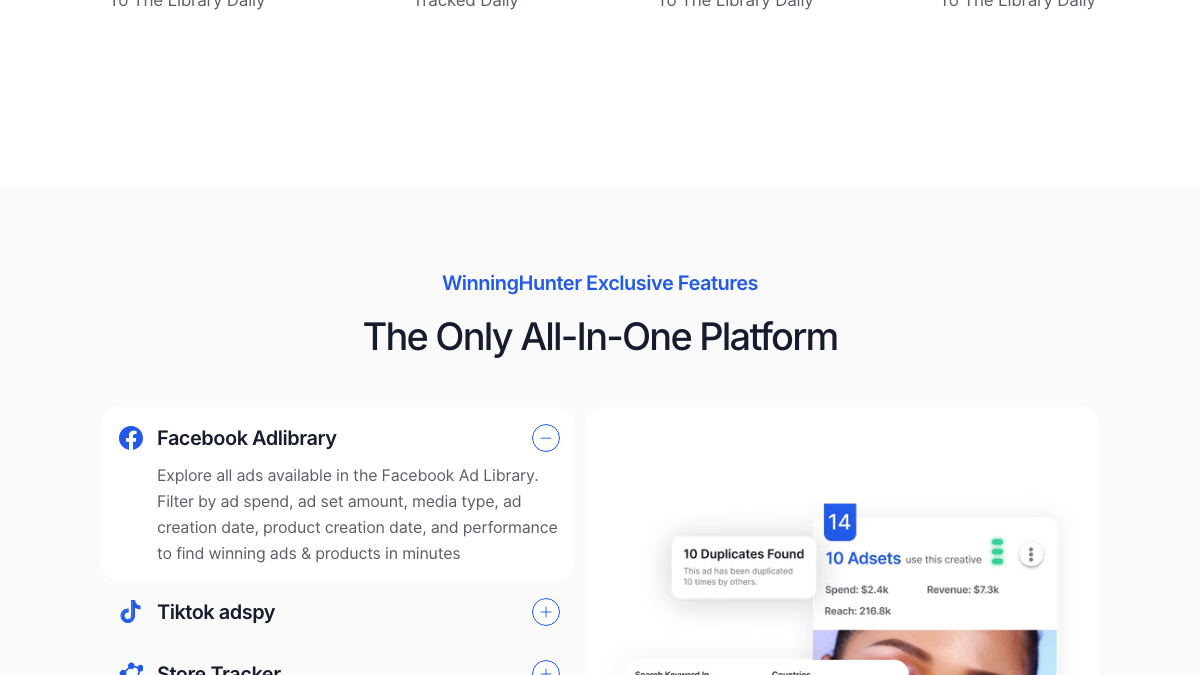
| Official navigation lists Facebook Ad Spy, TikTok Spy Tool, Shopify Sales Tracker, Store Revenue Tracker, Exploding Trends, Trending Products, Spy Essentials, and AI Reverse Ad Search. | Map the product to ecommerce research jobs. | Feature names do not prove data quality for your niche. | Workflow |
| Official docs list API and MCP access for TikTok Shop, Meta ads, brands, trends, and Shopify discovery. | Automate repeated research after manual validation. | Requires account API access and credit planning. | API |
| Official pricing page lists monthly plan cards starting at $49. | Decide whether feature access is worth paying for. | Plan limits and naming can change. | Pricing |
| Official comparison content positions Winning Hunter against Minea for ecommerce research and competitor analysis. | Compare ad intelligence versus broader validation. | A vendor comparison is not neutral evidence. | Alternatives |
Useful for finding active ad angles and competitor creative patterns. Limit: ad activity still needs freshness checks.
Useful for building a shortlist. Limit: discovery signals do not prove margin or demand stability.
Useful for understanding competitor stores and positioning. Limit: plan limits and tracked store counts matter.
Useful for spotting movement. Limit: trend signals can be late or noisy.
Useful for repeatable research automation. Limit: credits, rate limits, and access gates matter.
Not a product feature, but still required before launching ads or buying inventory.
| Workflow job | Useful feature | Pricing/API impact |
|---|---|---|
| Find product candidates | Product discovery and trend signals. | Search volume and filters can trigger plan review. |
| Validate competitor activity | Ad research and store tracking. | Tracked stores and advanced filters can trigger upgrades. |
| Prepare weekly research brief | API/MCP and saved research outputs. | API access, credits, and rate limits matter. |
| Compare other tools | Ad, product, store, and API coverage. | Alternatives may be better for narrower jobs. |
Use the official product pages to inspect the capability you need, then confirm its availability on the plan you are considering. Feature breadth alone is not a reason to upgrade.
Features only matter commercially if they save repeated research time or unlock a workflow you actually use.
PricingAutomation should come after manual workflow validation because credits and rate limits shape the build.
APIIf Ad Spy dominates your use case, a narrower tool may be better.
AlternativesUse a focused page when one platform or capability owns the decision.
Connect store and product signals to a manual Shopify validation checklist.
Shopify workflowUse ad and product signals to narrow candidates before checking shipping and margin.
TikTok Shop workflowStudy creative patterns, filters, and competitor signals with clear human checks.
Ad Spy workflowFollow one focused tutorial for turning a store into a research brief.
Store tutorialTurn ad references into one original creative brief with a hypothesis and a test.
Creative analysis tutorialFact-check note
Fact-check note: Last checked: August 12, 2026
Sources checked:
Plan names, prices, API access, credits, and limits can change. Verify the live official pages before buying or building an integration.
Product discovery, ad research, store tracking, competitor analysis, trend signals, and API access matter most because they change workflow and pricing decisions.
No. Features provide signals, but product selection still needs manual validation through social search, competitor store review, margin checks, and ad testing.
Yes. Official docs describe API and MCP access, API keys, metered requests, credits, and rate limits. Check account access before building.
Store tracking, higher-volume research, API access, and repeated weekly workflows are the main reasons to care about plan limits and upgrade triggers.
Compare alternatives if you mostly need ad creative research, Shopify-only store spying, a lower price, or a simpler beginner workflow.
No. Features explain what the product can do. Tutorials explain how to complete one task without turning the page into another review.
Decision
Features matter only when they change a workflow decision. Use Pricing for plan limits, API for automation, and Alternatives when your job is narrower than Winning Hunter's broader research scope.